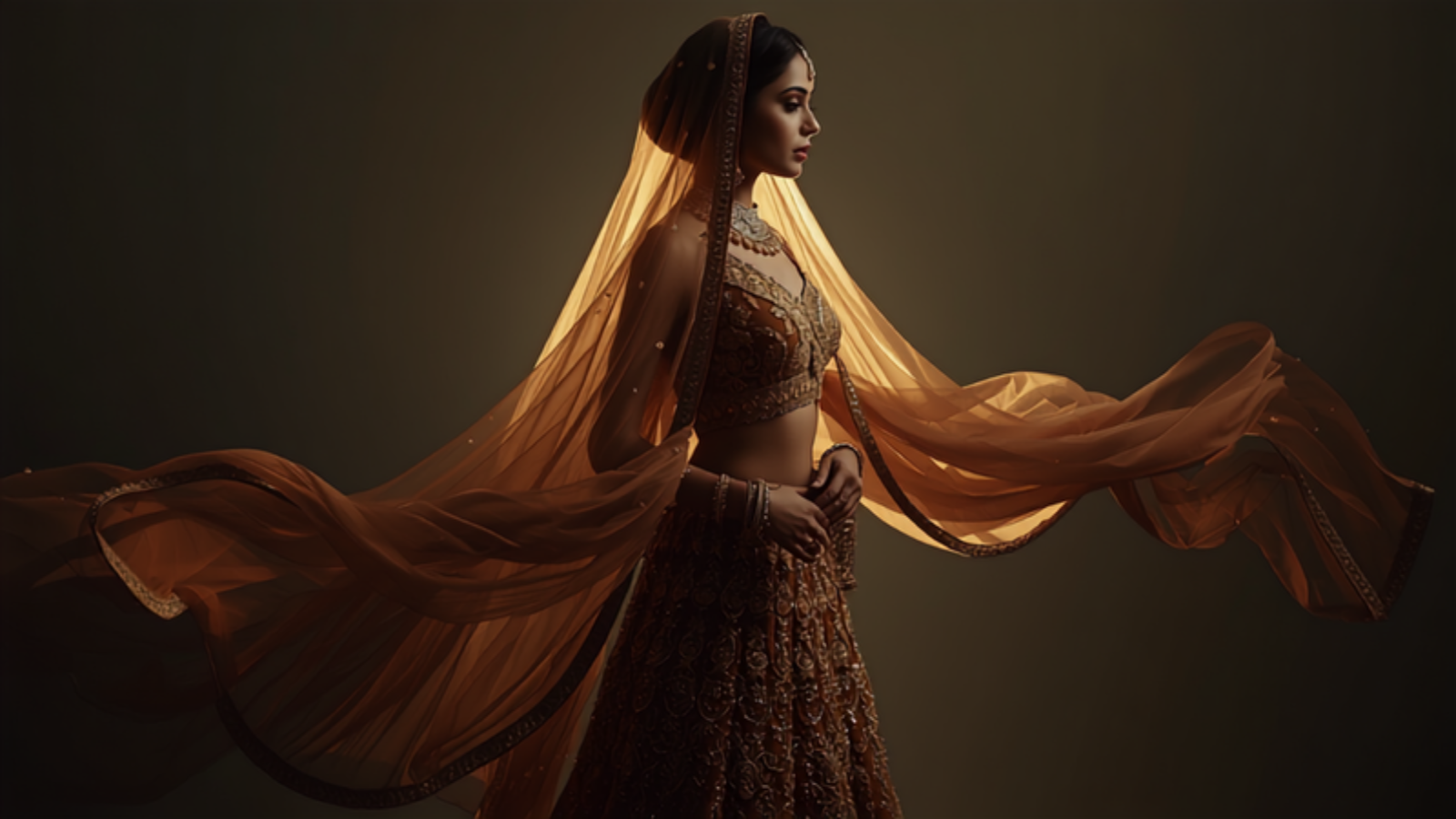
A bride sat across from me last week, holding up a photo on her phone of a dupatta pinned in the classic pallu-over-the-head style her mother wore in 1994, and asked if that was still "correct." I told her what I tell every bride who asks me that question: there is no one correct way to wear a dupatta anymore, and the most exciting shift I'm seeing across my bridal calendar this year is exactly there, in how we finish the drape.
For years the dupatta was treated as an afterthought, something pinned on at the last minute once the lehenga and blouse were decided. Not anymore. This wedding season, the drape itself has become a design decision, and one of the biggest departures I'm styling into my brides' wardrobes is the cape. A structured cape, often in organza or a stiffened tissue, replacing the traditional pallu at the Sangeet or reception, worn over the shoulders like a second garment rather than pinned into the hair. It reads modern and architectural, but it still does the emotional work a dupatta has always done for an Indian bride: it frames her face, it adds drama when she walks, and it gives the whole silhouette a sense of occasion.
The Aesthetic: Structure Meets Softness
What I love about this shift is that it doesn't abandon tradition, it reinterprets it. The colour story this year has moved well past red and gold into deep emerald, midnight teal, burnt terracotta and frosted lilac, often in ombre gradients that shade from a rich base into something pale at the hem. Against that kind of palette, a stiff-shouldered cape in matching or contrasting tissue catches the light in a completely different way than a soft chiffon pallu ever could. Fabric is doing the heavy lifting here. Organza and tulle bring lightness and movement, while raw silk and tissue bring body and shine, and knowing which one to reach for depends entirely on the function, the venue and how much the bride wants to be seen from across the room.
The Stylist's Touch: Reading the Body, Not Just the Trend
I never let a bride choose a drape because it is trending. I choose it because of what her body and her day need. A cape adds width and presence at the shoulder, which is a gift for a bride with a narrow upper body who wants more visual weight up top on camera. It is less forgiving on a bride who is petite through the torso and wants length, where I would rather keep her in a traditional front pallu or a one-shoulder throw that elongates the line instead of interrupting it. The corset-style blouse that is everywhere right now, with its sculpted bodice and boned structure, actually pairs beautifully with a cape because both pieces share the same architectural language. Pair a soft, unstructured blouse with a stiff cape and the whole look starts to argue with itself.
Draping for the Multi-Day Bride
This is where the real craft lives for me, because almost none of my brides wear one lehenga anymore. A wedding today is Mehendi, Haldi, Sangeet, sometimes a cocktail night, then Phere, and often a reception two days later, and every one of those functions needs its own draping language, not just its own outfit. My rule of thumb: keep the Haldi and Mehendi drapes soft and low-maintenance, a simple front pallu or a loosely pinned side drape in cotton silk or georgette, because these are dance-heavy, high-movement days. Save the cape or a sculpted one-shoulder throw for the Sangeet or reception, where the bride is seated for portraits and entrances more than she is dancing through a crowd. And for the Phere itself, I almost always bring the dupatta back to something closer to tradition, whether that's a nath-anchored head drape or a gota patti bordered pallu that nods to her family's customs, because that is usually the one moment brides don't want reinvented.
Building the Wardrobe Around the Drape
When my brides come to me for multi-day curation, I don't start with silhouettes, I start with a drape map for the week. It sounds backwards, but a dupatta or cape dictates blouse neckline, jewellery placement and even hairstyle far more than people realise. A structured cape needs a cleaner neckline underneath so the two don't compete, and it usually means simpler earrings and a statement neckpiece rather than the reverse. A soft, layered pallu can carry heavier jhumkas and a fuller maang tikka because there is less structural noise around the face. This is the part of styling that never makes it into the reels, the quiet decisions about what a two-inch shift in drape does to everything else the bride is wearing that day.
Practical Takeaways for Your Own Wedding Wardrobe
Match your drape to the function, not the other way around: soft and low-maintenance for Haldi and Mehendi, structured for Sangeet and reception, traditional for Phere
Choose cape-style draping if you want more visual presence at the shoulder or are petite through the torso and need width, skip it if you want length
Let your dupatta fabric echo your blouse structure: stiff tissue and organza pair with corset or boned blouses, soft chiffon and georgette pair with unstructured ones
Decide jewellery after the drape, not before, since a structured cape usually calls for cleaner earrings and a statement neckpiece
If you love the ombre and jewel-tone palettes trending this year, ask your draper to let the gradient show at the hem of the cape rather than hiding it in the folds
Every bride I dress is the Creative Director of her own wardrobe, and my job is to translate her Style DNA into decisions like these, the ones nobody notices until they see the photographs and realise why everything just looked right. Whether you are eight months out from your wedding or scrambling with six weeks left, if you want a wardrobe that is curated function by function instead of assembled outfit by outfit, I would love to sit down with you.
With love and style,
Shreya Gupta Kedia
Founder, SGK Styles


